
Feature — Segmentation
Stop analysing the
loud minority.
Not all community voices carry equal weight. Levellr's Segmentation lets you filter by actual engagement, tenure, and spend — not just static Discord roles — so every insight you act on reflects the members who actually matter to your business.


What segmentation does
Focus on the cohorts that drive revenue and retention.
A massive, unorganised community is just noise. Segmentation turns that noise into clear, understandable groups — so you can stop guessing what your players want and start knowing.
Behavioural, not just roles
Filter by actual engagement, tenure, and in-game spend — not just the static Discord roles that tell you nothing about what a member actually does.
Instant cohorts
Isolate your top 5% users, new members from the last 7 days, or at-risk players showing churn signals — in one click, with no data science required.
Applies everywhere
Once defined, segments carry across Levellr's entire suite. Apply them to Search, Sentiment, and Social Listening to see exactly what each cohort is saying.
Segment Builder
Build the cohorts that matter. No data scientist needed.
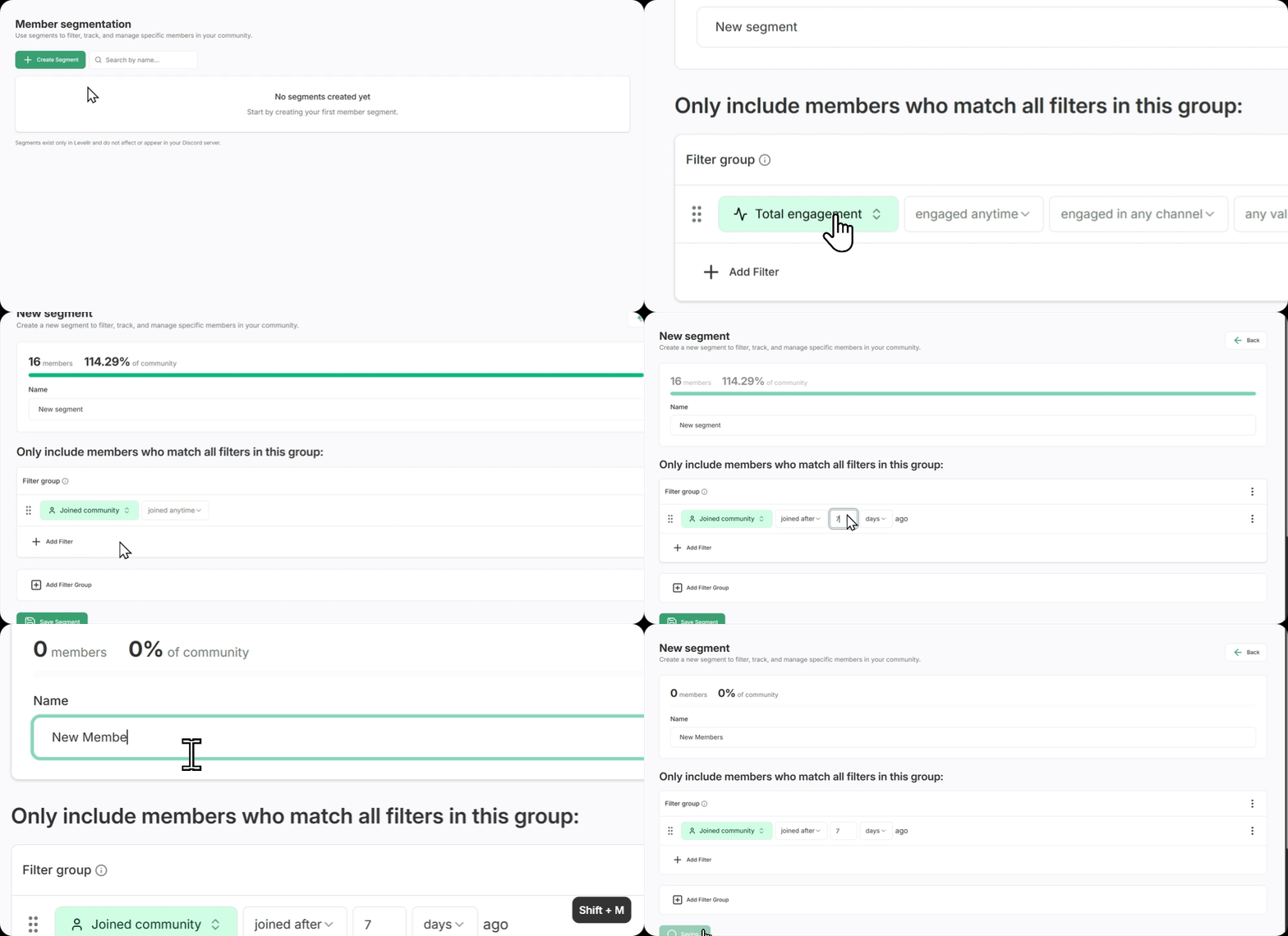
Levellr's segment builder is powerful but requires no technical expertise. Start with a clean slate, add filters for profile data, engagement activity, and time, and combine them to build exactly the group you need. The result is a named, reusable cohort you can query against any Levellr tool.
- Filter by profile data: joined date, last seen, Level, XP, or Discord role
- Filter by engagement: message frequency, channel activity, event participation
- Combine multiple filters with AND/OR logic — without writing a query
- Save and name segments to reuse across reports, sentiment tools, and AI search
Cross-Tool Intelligence
Define once. Apply everywhere that matters.
A segment is only useful if you can do something with it. Once you've defined a cohort in Levellr, it becomes a persistent lens you can apply across the entire intelligence suite — so you're always looking at the right slice of your community, not the whole noisy bucket.
- Apply segments to Levellr AI to ask "what do my top spenders think about this update?"
- Run Social Listening reports filtered to your most engaged members only
- Compare sentiment between cohorts — superfans vs new members vs at-risk players
- Weight your feedback by who is speaking, not just how many messages they sent
How teams use it
The segments that change how you understand your community.
From retention to research, segmentation unlocks a new layer of strategic intelligence that server-wide data simply can't provide.
Identify and understand your superfans
Create a segment of highly active members with a Beta Tester role who've been in the server for over a year. Monitor their feedback on new features and understand what keeps your most valuable advocates invested.
"What are our top 100 most engaged members saying about the new season pass?"
Proactively identify churn risk
Filter for members whose level is above 20 (so they were once engaged) but who haven't been seen in over 14 days. Analyse this group to find common patterns — did they all go quiet after a specific update?
"Are our at-risk players talking about a competitor, or is there something specific driving disengagement?"
Improve new player onboarding
Build a segment of everyone who joined in the last 7 days and monitor their engagement patterns. Are they talking? Are they getting stuck? Identify where new members drop off before it affects retention metrics.
"What questions are new members asking this week that we're not answering well?"
Analyse feedback from the right audience
Need to know how a specific region is responding to localisation, or what high-spending players think about a new monetisation feature? Stop reading feedback from the wrong audience — segment first, then ask.
"How are players in Brazil reacting to the new localised content, compared to our global average?"
Questions
How Segmentation works.
Everything you need to know before getting started.
What data can I use to build a segment?
You can filter by profile data (join date, last seen, Level, XP, or Discord role), engagement activity (message frequency, channel participation, event activity), and time ranges. Filters can be combined with AND/OR logic — no SQL or technical knowledge required.
How is this different from Discord's built-in roles?
Discord roles are static labels assigned manually or by bots — they tell you what someone has been given, not what they actually do. Levellr segments are based on real behavioural data: how often someone messages, when they were last active, how long they've been in the server, and what channels they engage with. This gives you a far more accurate picture of who your community actually is.
Can I apply a segment to multiple Levellr tools?
Yes — that's one of the most powerful aspects of Segmentation. Once you've defined and saved a segment, you can apply it across Levellr AI, Social Listening, Sentiment, and Search. Your segment becomes a persistent lens across the entire intelligence suite.
How many segments can I create?
There's no fixed limit on the number of segments you can build. Most teams create 5–15 segments covering their core cohorts — superfans, new members, at-risk players, high spenders — and then add more as their analysis needs evolve. Speak to our team about what's right for your community size.
Does Levellr only work with Discord?
Whilst Discord is unique in the high volume of unstructured data that can be turned into decision-grade intelligence, Levellr also works with additional platforms such as Reddit, as well as customer data sources such as in-game chat. Segmentation can be applied across all supported data sources.
Is Levellr enterprise-ready and secure?
Yes. Levellr is ISO 27001 compliant and built for secure, scalable deployment across large organisations. Unlike hobbyist bots, Levellr is designed to handle millions of messages and member activity records while protecting user privacy and adhering to enterprise data standards.
Case studies
Segmentation in the real world.
How teams use Levellr to understand the specific groups that drive their business.
Consumer Tech
Google Pixel Redefines Brand Loyalty with Discord Superfans
Identifying and rewarding the most engaged community members — 89 engagement-driven rewards distributed to the superfan cohort, turning active members into vocal brand advocates.
Read case study → Consumer BrandHow Sneak Energy Transformed Community Data into Business Strategy
Using structured community intelligence to make product and marketing decisions grounded in what the most engaged customers actually think — not just the loudest voices.
Read case study → Gaming StudioHow Look North World Uses Levellr to Revolutionise Game Development
Routing player feedback from the right community segments directly into the development cycle — reducing the gap between what players say and what the studio builds.
Read case study →What our customers say
Trusted by the teams building on Discord.
Focus on the voices that actually matter.
See how product, Live Ops, and research teams use Levellr Segmentation to understand the specific cohorts that drive their decisions.
